

European Consortium Unveils Breakthrough Laser Technology for 2D Materials Integration in Silicon Photonics


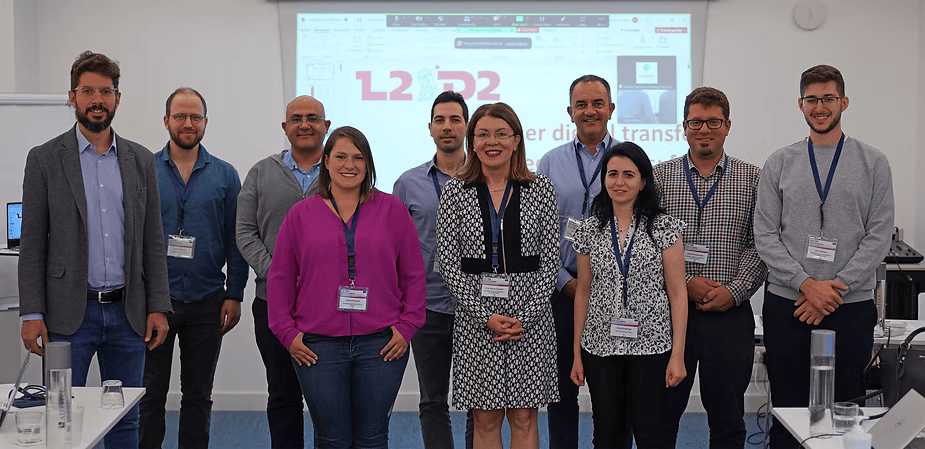
L2D2 team
Horizon Europe’s L2D2 project delivers scalable, solvent-free graphene transfer technology for next-generation photonic and electronic devices
ATHENS, GREECE, December 24, 2025 /EINPresswire.com/ -- The Horizon Europe project L2D2, funded by the European Innovation Council (Grant Agreement No. 101058079), today announced major technical achievements that could reshape the future of silicon photonics, semiconductor manufacturing, and high-speed data communications.
The project has developed a laser-based, single-step and solvent-free digital process for transferring graphene and other 2D materials onto CMOS-compatible and silicon photonics wafers up to 8 inches. This innovation, known as Laser Digital Transfer (LDT), addresses one of the most persistent bottlenecks in 2D materials integration: enabling selective, clean and defect-free, compatible with industrial upscaling.
L2D2 brings together leading research and industry partners—National Technical University of Athens (coordinator), Graphenea Semiconductor, NVIDIA Mellanox, Bar-Ilan University, and Exelixis Research Management & Communication—combining deep expertise in materials science, semiconductor engineering, and exploitation strategy.
A Technology Aligned with Global Market Demand
The graphene electronics market is projected to grow from USD 380 million in 2022 to USD 1.5 billion by 2027, driven by applications in telecommunications, photonics, sensing, and next-generation computing. Industry stakeholders have confirmed the urgent need for reliable, reproducible, and scalable 2D materials integration solutions.
LDT responds directly to this demand by offering:
• Laser transfer and patterning of 2D material “pixels” with feature sizes of <10 μm to >500 μm
• Wafer-level compatibility with 4-inch and 8-inch wafer platforms
• Clean transfer without polymer residues or solvent contamination
• Industrial reproducibility and automation potential
These capabilities open pathways for integrating graphene and other 2D materials into advanced nano-optoelectronic devices such as optical modulators, photodetectors, integrated transceivers and a plethora of sensors.
K. K. THANOPOULOU
Exelixis Research Management & Communication
email us here
Legal Disclaimer:
EIN Presswire provides this news content "as is" without warranty of any kind. We do not accept any responsibility or liability for the accuracy, content, images, videos, licenses, completeness, legality, or reliability of the information contained in this article. If you have any complaints or copyright issues related to this article, kindly contact the author above.
